Environmental language is now common in architectural material schedules, but the words are not always used in the same way. Recycled, recyclable, circular, low impact and sustainable can describe different things, and none of them replaces product-specific evidence.
For architects and interior designers, the aim is not to find the strongest slogan. It is to understand exactly what is being claimed, what part of the product the claim covers, how it was measured and whether the evidence is relevant to the proposed application.
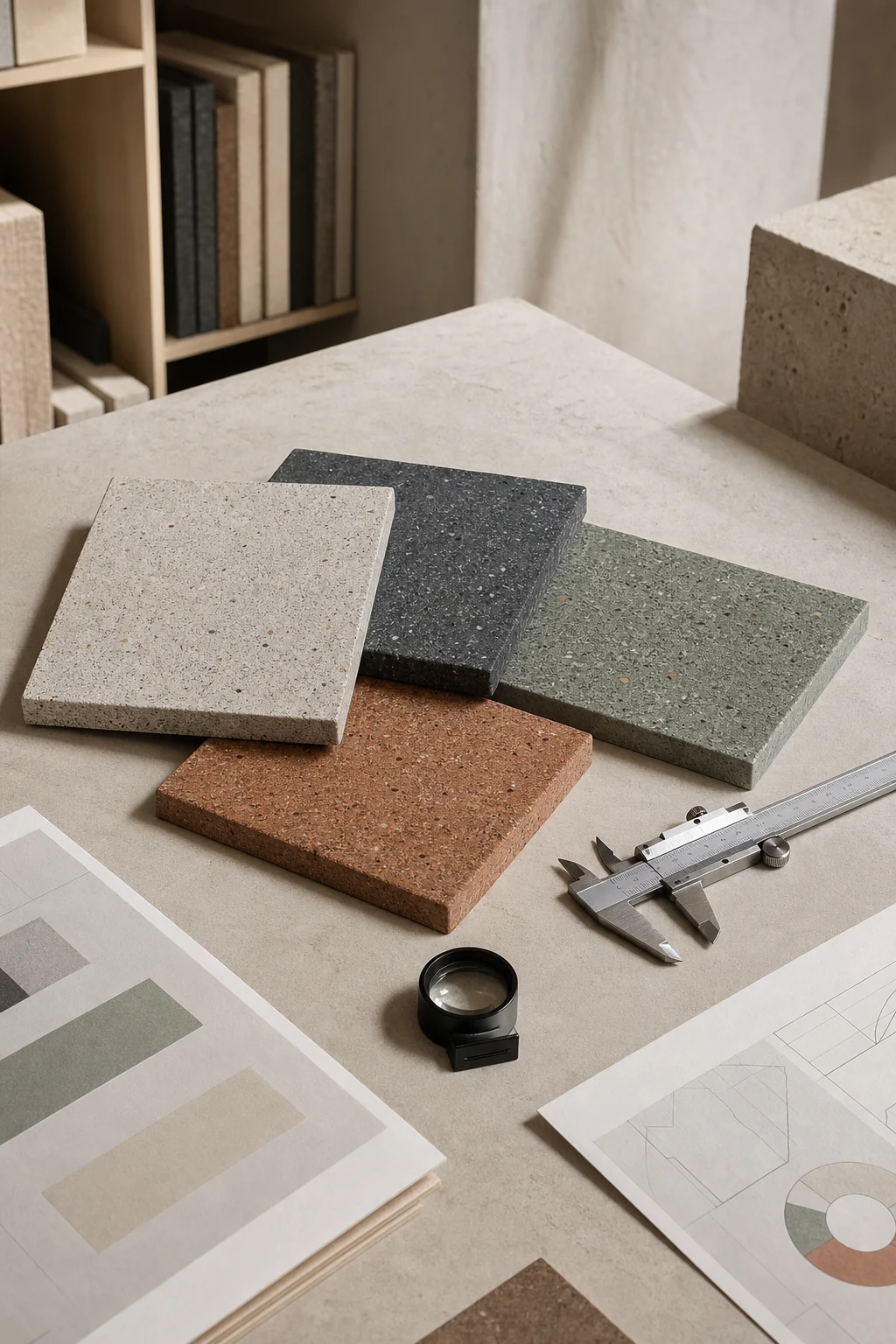
CLEM recycled mineral tiles are made using selected recovered mineral materials that are processed, combined with cement and wet-pressed into modular surfaces. That material story is important, but a responsible specification should still ask precise questions rather than infer a percentage, certification or whole-life result that has not been documented.
Begin by rewriting the claim as a question
Broad phrases such as green material, eco-friendly surface or sustainable tile are difficult to evaluate because they do not identify a measurable benefit. The Australian Competition and Consumer Commission advises businesses to make environmental claims that are accurate, evidence-based, clear about conditions and free from important omissions. The same principles are useful for a project team reviewing product literature.
Turn each statement into a question that can be answered. Instead of accepting made with recycled materials, ask: which materials, recovered from which waste stream, in what proportion, measured by what method, for which product and production period? Instead of accepting low impact, ask: lower than what baseline, for which environmental indicator and across which life-cycle stages?
A specific answer may be modest, but it is more useful than a sweeping claim. It can be recorded in the material schedule, checked during procurement and explained accurately to the client.
Distinguish recycled content from recyclability
Recycled content describes material already incorporated into a product. Recyclability describes whether that product may be collected and processed into another useful material at the end of its current life. They are not interchangeable. A tile can contain recovered material without being accepted by a local recycling system, and a theoretically recyclable product may still have no practical collection route in the project location.
The ACCC notes that consumers can understand recycled material as material that has already passed through a previous life cycle, while some technical definitions also include pre-consumer material diverted from a manufacturing waste stream. Where the source is pre-consumer, a clear claim should explain that rather than allowing readers to assume it is post-consumer waste.
For a project specification, record the claimed recycled content separately from any end-of-life pathway. If take-back, reuse or recycling is proposed, identify who will accept the material, where the facility operates and what conditions apply.
Identify the recovered material and its boundary
A useful declaration names the recovered input and the boundary of the claim. It should be clear whether the statement relates to the finished tile, one ingredient, the packaging, a product family or the manufacturer as a whole.
Ask whether the source is post-consumer material, pre-consumer material that would otherwise have entered a waste stream, or an internal production return. These routes may all support resource efficiency, but they describe different flows. Also ask whether water, binders, pigments, surface treatments and backing materials are included in the calculation.
Do not assume that a company-wide percentage applies equally to every colour, thickness or format. Custom production and alternative finishes may use different inputs. The evidence should identify the product or clearly state the range to which it applies.
Check how the percentage was calculated
A recycled-content percentage needs a calculation basis. It may be reported by mass, volume or another defined method. For a dense mineral product, percentage by mass is often the most readily understood, but the document should state the basis rather than leave it implicit.
Check whether the number is a measured value for a defined production period, a formulation target, a minimum guarantee or an average across several products. Ask how moisture, processing losses and non-recycled components are treated. If a percentage is important to a rating tool or client target, confirm the acceptable calculation method before relying on it.
The United States Federal Trade Commission Green Guides provide a useful international reference: partly recycled products should qualify the amount clearly, and pre-consumer material should genuinely have been diverted from the waste stream. Local law and project requirements still take priority, but the underlying lesson is broadly applicable: quantify the claim and retain substantiation.
Match each claim to the right level of evidence
Not every project needs the same document set. A small interior may rely on a clear manufacturer declaration supported by production records, while a certified building may require recognised third-party documentation. The evidence should be proportionate to the claim and to the consequences of getting it wrong.
A practical evidence hierarchy can include:
- a dated product-specific declaration that defines the claim and calculation method;
- supplier or production records supporting the recovered input;
- current laboratory reports for relevant physical performance;
- an independently verified Environmental Product Declaration where available;
- certification or responsible-product recognition required by the project rating tool;
- project-specific confirmation that the selected colour, finish and format are covered.
A test report answers the property it tested. It does not automatically verify recycled content or whole-life impact. In the same way, a recycled-content declaration does not demonstrate slip resistance, water absorption or suitability for a wet area. Keep environmental and performance evidence connected, but do not treat them as substitutes.
Understand what an EPD does and does not say
An Environmental Product Declaration presents quantified life-cycle information using defined Product Category Rules and an independent verification process. EPD International describes an EPD as objective, comparable and third-party verified information about the environmental performance of a product or service.
An EPD is a transparency document, not a universal badge proving that one product is environmentally superior. Read its declared unit, product coverage, geography, data period, system boundary, scenarios and expiry date. When comparing two EPDs, check that they serve an equivalent function and use compatible rules and assumptions. A number taken from one life-cycle module should not be presented as the impact of the complete product life cycle.
If an EPD is not available, the specification can still request precise, supportable information. Do not replace missing quantified data with a stronger adjective. State what is known, what has been verified and what remains outside the claim.
Avoid comparing unlike products
A lower number is only meaningful when the compared products perform the same task. Tile thickness, expected service life, maintenance, replacement frequency, installation materials and transport can all influence the result. Comparing one square metre of two surfaces without considering how they are installed or how long they remain in service can create a misleading impression.
The Green Building Council of Australia's Responsible Products Framework recognises product initiatives that address climate, environmental and health impacts and ongoing manufacturing improvement. For Green Star or another rating system, check the current project-specific rules and recognised documentation rather than assuming that any recycled-content statement earns the same outcome.
Keep durability and maintenance in the conversation
Recycled content is one attribute of a material. A complete selection also considers whether the surface is fit for the location, can be maintained with an appropriate cleaning regime and can remain in service for the intended period. Premature replacement can undermine an otherwise positive material choice.
Request current performance information for the exact product and finish. Coordinate the substrate, adhesive, grout, movement joints, sealing where applicable and maintenance instructions. A well-documented material that is unsuitable for the actual environment is not a responsible specification.
Durability should not be used as an unmeasured environmental claim either. If service-life assumptions form part of a comparison, record their source and make the assumptions visible.
Record transport, packaging and end-of-life separately
Manufacturing location and transport route can matter, but distance alone does not provide a complete impact assessment. Mode of transport, shipment efficiency, product mass and project logistics also influence the result. Ask for relevant information without converting a local or imported label into an automatic environmental conclusion.
Treat packaging as its own subject. Identify what the packaging is made from, whether it contains recycled content and whether it can be recovered through systems available at the project location. Do not allow a packaging claim to appear as though it describes the tile itself.
At end of life, prioritise realistic pathways. Retaining a durable installation, recovering spare tiles for repair, designing for careful removal and identifying an actual reuse or processing route are more credible than an undefined promise of future circularity.
Put the evidence into the specification
The value of material transparency is lost if it remains in an email inbox. Add the relevant requirements to the product schedule and submittal process. Record the product name, colour, finish, format, claim wording, percentage and calculation basis where applicable, supporting document, issue date and approval status.
If substitutions are permitted, require equivalent evidence rather than accepting a visually similar product with a different documentation boundary. Before purchase, confirm that the submitted documents still apply to the supplied product and have not expired or been superseded.
A concise review checklist
Before repeating an environmental claim in a design report or specification, ask:
- What exact product and component does the claim cover?
- Is the recovered input pre-consumer, post-consumer or another defined stream?
- Is the recycled-content amount stated, and what is the calculation basis?
- Is the claim product-specific, dated and supported by accessible evidence?
- Are recycled content and recyclability described separately?
- Does an EPD cover the selected product, and are its boundary and validity understood?
- Are comparisons based on equivalent function and compatible methods?
- Have technical suitability, durability and maintenance also been reviewed?
- Are packaging, transport and end-of-life statements clearly separated?
- Can the final wording be copied into the specification without exaggeration?
Good environmental communication is precise enough to be checked. For CLEM projects, request current product data, available test reports and material information for the selected tile rather than relying on a general description alone. That approach gives architects a clearer basis for comparison and allows the material story to remain credible from concept design through procurement.
Research notes
Sources & verification
- CLEM product pages, current product data and material test reports.
- https://www.accc.gov.au/about-us/publications/a-guide-to-making-environmental-claims-for-business
- https://www.iso.org/standard/14021
- https://environdec.com/home
- https://new.gbca.org.au/green-star/rating-system/responsible-products-framework/
- https://www.ftc.gov/legal-library/browse/rules/green-guides
Technical suitability and current availability should be confirmed for each project.
