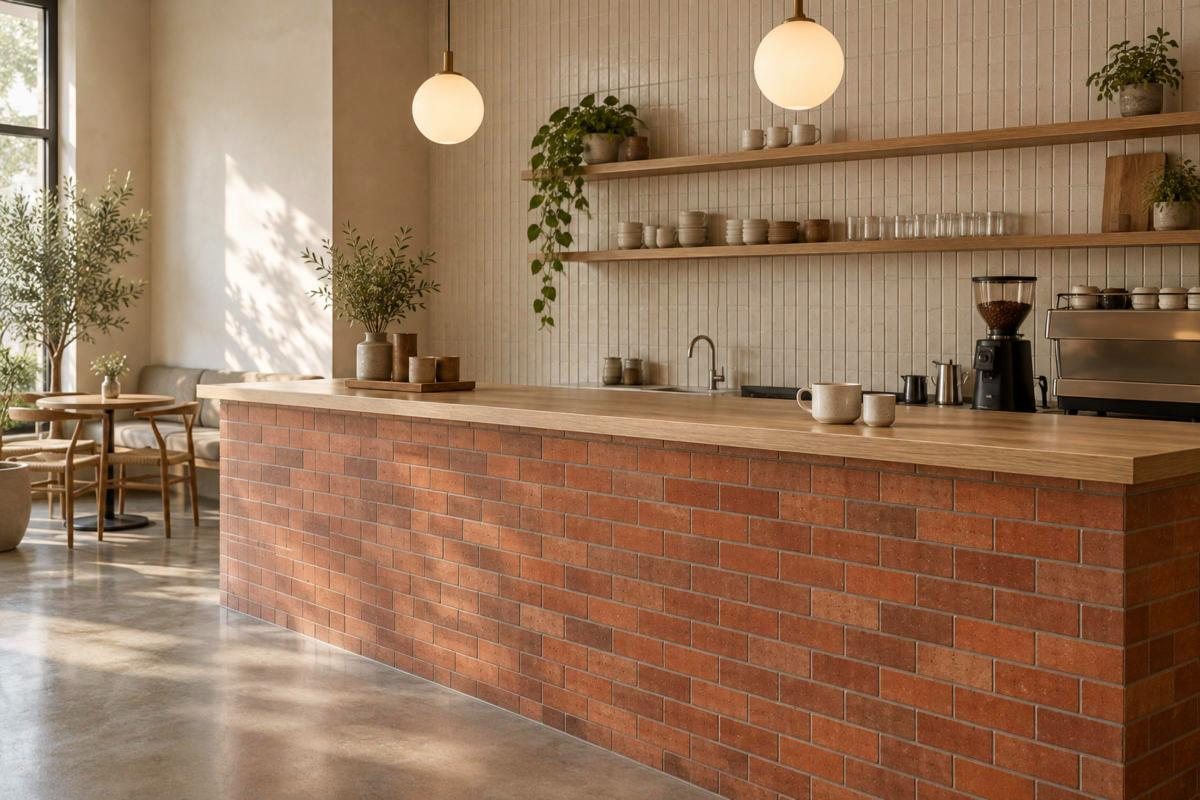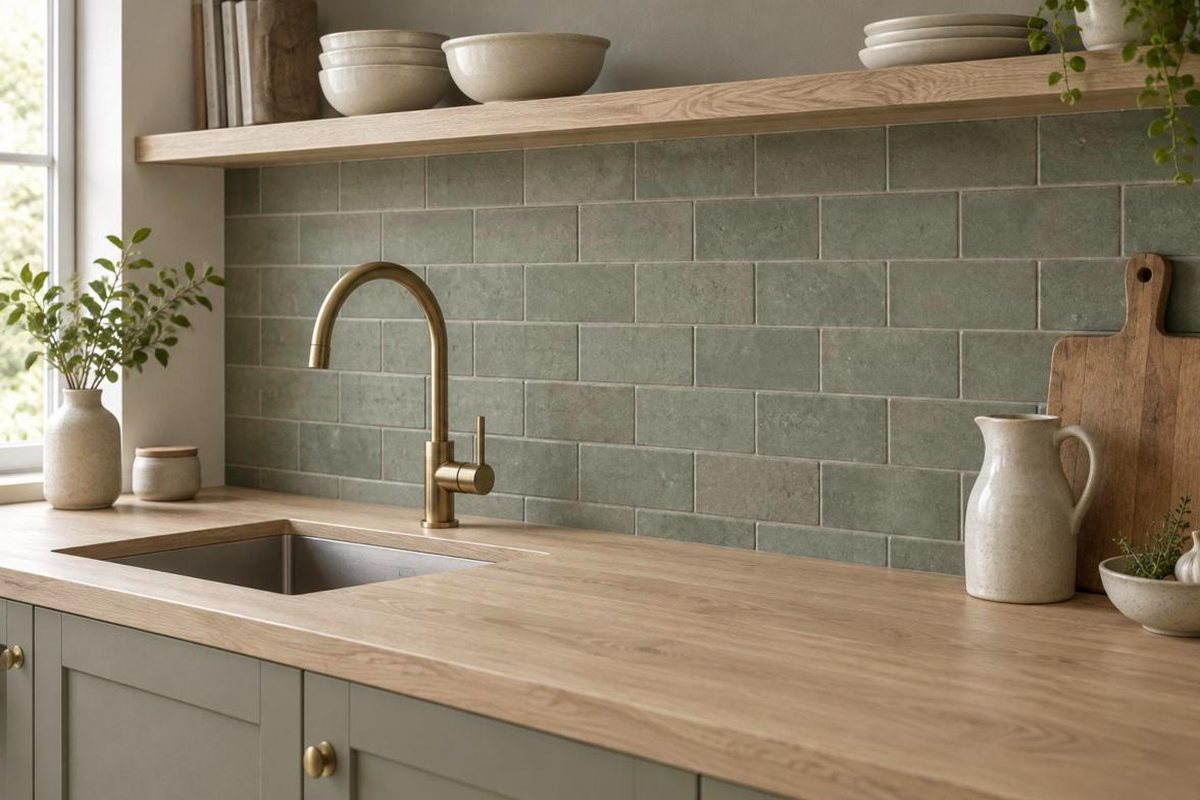
Metro tiles are not going out of style, but the way most people used them is. The version that now looks dated is the one that filled kitchens and bathrooms for years: bright white gloss tiles, bevelled edges, running bond and a mid-grey grout, repeated everywhere. The version that looks current keeps the same simple rectangle and changes four things: colour, finish, grout and layout.
This guide walks through each of those decisions, with examples from the matt metro tiles in the CLEM Colour Palette.
要点
- Are metro tiles still in fashion? Yes, as a format. Coloured, matt and hand-finished metro tiles read as current; plain white gloss with dark grout is what reads as dated.
- Which grout colour? Pick a grout close to the tile for a calm wall, lighter or darker only if you want every tile outlined.
- Which layout? Running bond is the safe classic, vertical stack looks the most modern, herringbone is a feature for smaller areas.
Metro tiles or subway tiles?
They are the same thing. "Metro tiles" is the usual name in the UK; Australia and North America say "subway tiles". The classic size is 7.5 × 15 cm (3 × 6 in), a rectangle twice as long as it is high. Slimmer 5 × 15 cm (2 × 6 in) and 3.6 × 15 cm (1.5 × 6 in) tiles give the same look with a finer rhythm.
Colours that keep metro tiles looking current
Colour is the biggest single change you can make. A coloured metro tile turns a background into a feature without changing the shape people already like.
| 色 | 見え方 | 向いている場所 | CLEM カラーパレット |
|---|---|---|---|
| Sage green | Calm, natural, slightly vintage | Kitchen splashbacks, bathrooms, cafés | C04 セージミスト, C15 ミストセージ, C17 グラファイトセージ |
| Cream and off-white | Softer than bright white, warm with timber and brass | Kitchens where white looked too stark | C05 アイボリーストーン, C03 温かい砂 |
| Dusty pink | Muted, not sugary | Bathrooms, cloakrooms, café counters | C16 ダスティローズ, C13 ブラッシュクレイ |
| Terracotta and burnt orange | Warm, Mediterranean | Restaurant walls, bar fronts, warm kitchens | C02 テラコッタレッド, C11 焼きテラコッタ |
| Charcoal | Graphic and strong | Bar fronts, contrast walls, borders | C08 チャコールブラック |
If you are torn between two greens or two creams, order both and look at them in the actual room. Greens in particular shift a lot between daylight and warm evening light. More green options are on the セージグリーンタイル page.
Which grout colour for metro tiles?
Grout decides whether the wall reads as one surface or as a grid of individual tiles.
- Grout close to the tile colour gives a calm, solid wall. The tiles' own tonal variation does the work. This is usually the safest choice for coloured metro tiles.
- Lighter grout softens the wall and makes it feel airy, but on a mid or dark tile it draws a clear white line round every piece.
- Darker grout outlines every tile and makes the layout pattern the main feature. It suits graphic layouts such as herringbone, and it hides marks on busy surfaces, but it is the look most associated with the dated white-gloss metro wall.
Starting points that work for most projects:
| Tile colour | Calm look | Defined look |
|---|---|---|
| Sage green | Warm mid-grey or soft green-grey | Off-white |
| Cream or ivory | Light sand or ivory | Warm grey |
| Dusty pink | Light sand or pale pink-beige | Warm grey |
| Terracotta | Sand or warm beige | Off-white |
| Charcoal | Dark grey or charcoal | Light grey |
What grout colour goes with green metro tiles? For sage or grey-green, a warm mid-grey grout keeps the wall calm; off-white gives a fresher, more defined look. A very dark grout on green tends to look heavy unless the wall is small.
Before you commit, make a small sample board with real tiles and two grouts side by side, and look at it where the tiles will go.
Different ways to lay metro tiles
The same tile can look traditional or very modern depending on the layout.
| Layout | How it looks | Practical notes |
|---|---|---|
| Running bond (brick bond) | The classic metro wall, each row offset by half a tile | Easiest to set out; forgiving of slightly uneven walls |
| Horizontal stack bond | Clean, modern grid with joints lined up | Joints must be straight, so the wall and setting-out need care |
| Vertical stack | The most contemporary look; makes walls feel taller | Works especially well with slim 5 × 15 or 3.6 × 15 cm tiles and on bar fronts |
| Herringbone | A strong feature; draws the eye | More cuts at every edge, so allow extra tiles and labour; best on a defined area such as a splashback |
A layout with lined-up joints, such as stack bond, shows every slight difference in tile size or wall flatness. Running bond hides more. If you want stack bond, ask your tiler to set out the wall from the centre so cut tiles at both ends are equal.
More brick-style layouts are covered on the brick tiles page.
Matt or gloss metro tiles?
Gloss bounces light and wipes clean easily, which is why it became the default. Matt metro tiles look softer and more natural, show fewer reflections and suit timber, stone and brass. They are a good fit when you want the wall to feel crafted rather than clinical.
Ask how a matt tile should be sealed and cleaned in a kitchen, where grease and splashes are part of daily use.
Tips for a metro tile kitchen splashback
- Decide where the tiling stops. Finishing at a shelf, the underside of wall cabinets or the full ceiling height looks intentional. Stopping at a random line looks unfinished.
- Plan around sockets and the window. Try to land socket edges on grout lines rather than in the middle of a tile.
- Set out from the centre of the main feature, such as the hob or sink, so the cuts at each end match.
- Choose the edge finish. Decide early how exposed edges will be finished: a trim, a neat cut edge or a return.
- Order samples of two colours and two grouts, and look at them under your own lighting before ordering the full quantity.
Where CLEM metro tiles fit
CLEM metro tiles are recycled stone tiles, not glazed ceramic. Recovered stone powder is mixed with cement and wet-pressed, then the colours are mixed by hand and the edges and surface texture are finished by hand. That gives the matt, slightly varied face described above, in the standard 7.5 × 15 cm metro size and the slimmer linear formats, across the CLEM Colour Palette.
They suit feature walls, splashbacks, café and restaurant interiors and bar fronts. Pricing, minimum order and lead times are on the metro tiles page and the trade page. For floors, ask first: slip-resistance results are not yet available.
よくある質問
Are metro tiles going out of style? The format is not. What looks dated is white gloss with bevelled edges and dark grout used everywhere. Coloured, matt or hand-finished metro tiles in a considered layout look current.
What size is a metro tile? The classic size is 7.5 × 15 cm (3 × 6 in). Slimmer 5 × 15 cm and 3.6 × 15 cm versions are also common.
Should metro tiles be laid horizontally or vertically? Horizontal running bond is the classic. Vertical stack looks more modern and makes a wall feel taller.
What grout goes with sage green metro tiles? A warm mid-grey or soft green-grey for a calm wall; off-white for a more defined, fresher look.
Are metro tiles and subway tiles the same? Yes. "Metro" is the UK name and "subway" is the Australian and North American name for the same rectangular tile.
Comparing colours for a kitchen, bathroom or café? サンプルをリクエストする and tell us the wall size and your timeline.
研究ノート
出典と検証
- Search research, 13 to 17 November 2026: Google Ads Keyword Planner (UK) and Google autocomplete (UK and Australia). Common questions include whether metro tiles are going out of fashion, which grout colour to use with green metro tiles, different ways to lay metro tiles and metro tile kitchen colours.
- CLEM metro tiles page, checked 17 November 2026: formats 7.5 × 15, 5 × 15 and 3.6 × 15 cm; CLEM Colour Palette colours; floor slip-resistance results not yet available. https://www.Clemstonetiles.com/metro-tiles.html
- CLEM production information confirmed by CLEM on 11 November 2026: recovered stone powder with cement, wet-pressed; colours mixed by hand; edges trimmed and surface texture worked by hand.
- Colour, grout and layout guidance is editorial design advice, not a product-performance claim. All three images are AI-generated concept images created for this article, not photographs of CLEM products or projects.
技術的適合性と現在の可用性はプロジェクトごとに確認する必要があります。