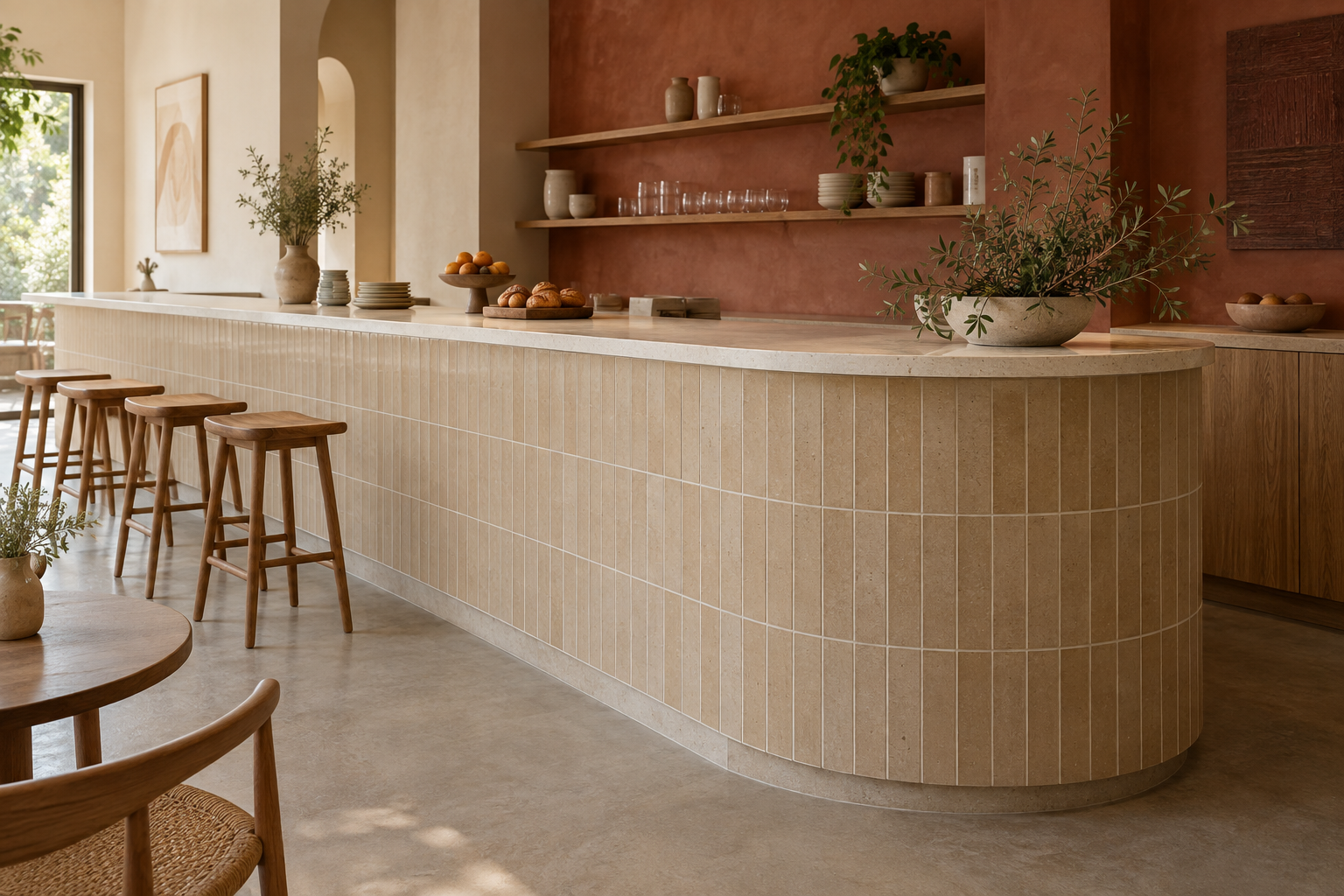
The phrase handmade tiles describes a quality that many designers value: visible variation, tactile surfaces and evidence of making. It does not, however, identify one material or one performance standard. A handmade tile may be hand-moulded clay, hand-cut terracotta, a hand-painted glazed tile or a cement-based piece formed by a different process. That distinction matters when a tile is being specified for a restaurant, hotel, retail interior or another commercial project. The words used on a mood board should not replace information about composition, forming, finish, tolerances, installation and maintenance.
What makes a tile genuinely handmade?
In its clearest technical sense, a handmade tile is shaped, moulded or cut by hand before it is dried, fired or cured. The forming process commonly leaves small differences in edge line, thickness, surface relief, colour and shape. Those differences are not automatically defects; they are often the reason the material is selected.
Handmade clay and terracotta tiles may also show variation created by the raw material, hand-applied glaze and position in a kiln. Handmade cement tiles follow another production route. The category therefore describes a degree of manual forming, not one universal recipe.
Before specifying a handmade tile, confirm exactly what is done by hand. Ask whether the body is hand-moulded, whether only the glaze or decoration is hand-applied, and whether the supplier uses handmade to describe production or simply appearance.
What are handmade-look tiles?
Handmade-look tiles are manufactured with machinery but designed to reproduce some visual qualities associated with handmade surfaces. Their edges, relief, shade range or pattern may vary from piece to piece even though the body is produced through a controlled industrial process. This can help when a project wants an irregular or crafted appearance together with more repeatable sizing, greater availability or a particular technical body.
It is still important to describe the product accurately. Handmade-look does not mean handmade, and visual similarity does not make the composition, installation method or performance identical.
Where do artisan and handcrafted fit?
Artisan tiles and handcrafted tiles are common design and marketing expressions, but they are not precise material standards. They may refer to genuine hand production, hand-applied decoration, small-batch work or simply a surface with crafted character. In a specification, pair the descriptive term with the actual process.
Phrases such as artisan-inspired recycled mineral tiles, wet-pressed tiles with handcrafted character or custom-coloured compacted stone tiles communicate the visual intention without hiding how the product is formed.
How CLEM recycled mineral tiles are made
CLEM is not a traditional hand-moulded clay brick or a kiln-fired handmade tile. Selected recovered building material, including stone fragments and mineral matter, is collected and ground. The prepared material is mixed with cement and wet-pressed at approximately 300 to 400 tonnes to form the tile body.
After pressing, pieces rest for one week and are inspected for deformation. Accepted pieces move to colour and surface customisation. Deformed pieces return to the grinding stage so the material can re-enter production. The finished tiles are then checked, packed and prepared for delivery.
The character of a CLEM surface comes from visible mineral grain, natural tonal movement, custom colour work, tactile finishing and the relationship between modules. The accurate product description is therefore a wet-pressed recycled mineral tile with artisan-inspired character, not a handmade brick.
Handmade brick and brick-format tile are not the same
Handmade bricks usually belong to masonry, heritage or restoration searches. They are commonly described through clay selection, hand moulding, dry pressing, kiln firing, brick matching and load-bearing or facade use. A recycled mineral tile should not borrow that product identity simply because it has a rectangular format.
Brick-format tiles describe proportion and layout rather than masonry construction. CLEM rectangular modules can create stacked, running-bond or linear fields while remaining part of a tile system. The exact wall, floor, wet-area or exterior suitability must still be confirmed for the selected product and finish.
Compare the specification, not only the mood
When comparing handmade tiles, handmade-look tiles and recycled mineral tiles, review:
- material composition and recovered or recycled inputs;
- whether the body is hand-formed, machine-pressed, extruded, cast or otherwise produced;
- whether colour is integral, applied, glazed, printed or developed through the material itself;
- expected variation in tone, texture, edge, thickness and dimensions;
- available square, mosaic, geometric and brick-format modules;
- surface finish and project-specific performance evidence;
- sealing, adhesive, grout, joint and maintenance requirements;
- order quantity, lead time, batch control and replacement stock;
- availability of representative physical samples and mock-ups.
A useful sample review includes several pieces rather than one ideal tile. Arrange them with the proposed grout, adjacent materials and actual lighting. This reveals whether the variation feels intentional at the scale of the finished wall or floor.
Which term describes the design intent?
Handmade tiles is the clearest category phrase when the body is genuinely formed by hand. Handmade-look tiles describes a machine-made product created to reproduce that visual language. Artisan tiles and handcrafted tiles express craft, individuality and surface character but should be supported by a specific production explanation.
Custom tiles describe a different benefit: colour, format, pattern or finish developed for a project. Brick-format tiles describe a rectangular module and layout opportunity. Commercial tiles describe the intended market but still require technical confirmation for the actual location.
For CLEM, the strongest accurate combination is recycled mineral tiles, custom tiles, brick-format tiles and commercial tiles, supported by phrases such as tactile variation, handmade character and artisan-inspired finish. This language connects design intent with an honest material story.
Choosing the right character for a project
Choose a genuinely handmade tile when visible manual forming and one-off variation are central to the design story. Choose a handmade-look product when the desired visual effect needs to be balanced with the repeatability or body of another manufacturing system. Consider a recycled mineral tile when recovered material, compacted construction, custom colour and modular architectural layouts are important to the brief.
No category is automatically better. The right choice is the one whose material, making, appearance and verified performance align with the project. Explore CLEM recycled mineral colours, brick formats and geometric modules, or request physical samples and specification support for a commercial interior.
Research notes
Sources & verification
- CLEM production process and current product documentation.
- https://www.clemstonetiles.com/journal-how-clem-recycled-mineral-tiles-are-made.html
- https://www.perini.com.au/we-explain-the-difference-between-handmade-handmade-look-tiles/
- https://lincolnbricks.com.au/
- https://wiserit.co.uk/free-seo-tools/seo-keyword-tool/
- https://trends.google.com/trends/explore?geo=AU&q=handmade%20tiles,handcrafted%20tiles,artisan%20tiles,handmade%20bricks,handcrafted%20bricks
Technical suitability and current availability should be confirmed for each project.