Choosing a tile is not only a question of colour or size. The material route behind the surface affects its texture, available formats, installation requirements, maintenance and the evidence a designer should request before specification.
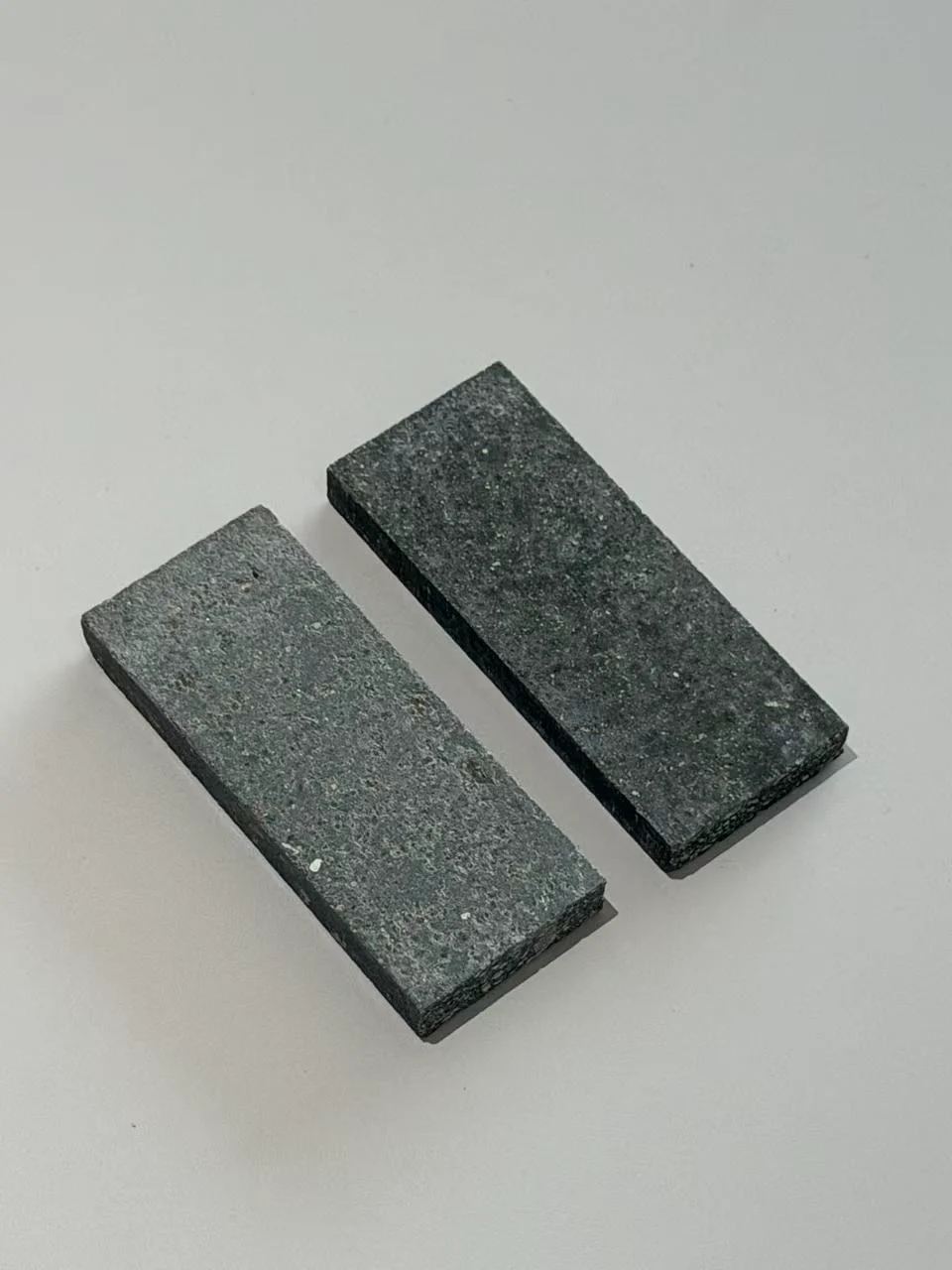
CLEM recycled compacted stone tile is sometimes visually compared with ceramic tile, porcelain, terrazzo or natural stone. There are useful similarities, but the materials are not interchangeable. CLEM starts with selected recovered matter, including mineral material from stone processing, and turns it into a new modular surface through grinding, mixing and wet pressing. Ceramic and porcelain tiles are fired products. Terrazzo is an aggregate-and-binder system that is normally polished. Natural stone is quarried and cut from geological material that already exists as stone.
Understanding those differences makes it easier to select a surface for the right reason.
How CLEM begins: recovered matter becomes a new tile body
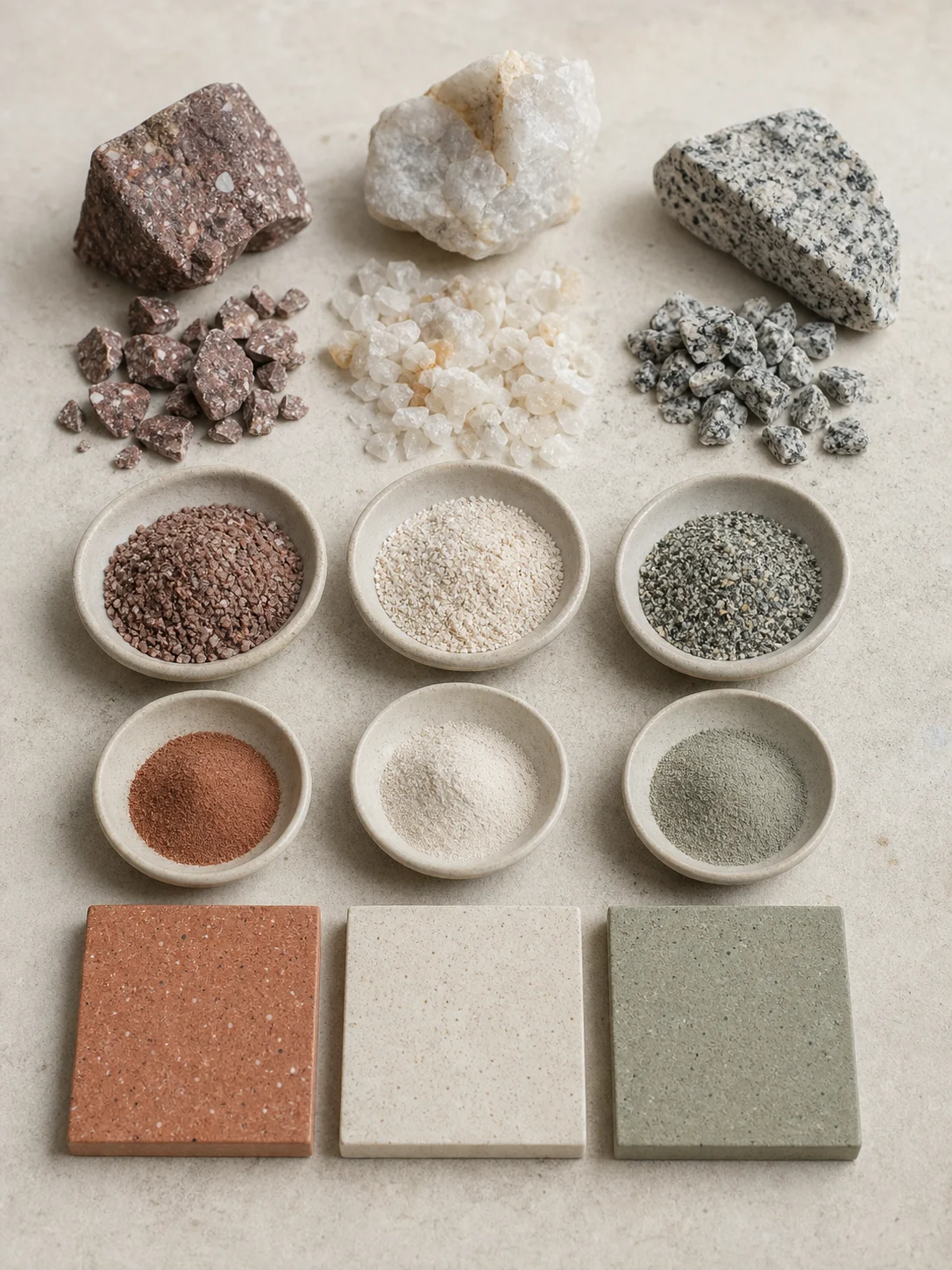
CLEM production begins by collecting and sorting selected recovered materials. The current process can include stone fragments and other suitable building offcuts. The material is ground into a fine powder, mixed with cement and formed by wet pressing at approximately 300 to 400 tonnes of pressure.
After pressing, the pieces rest for one week before inspection and sorting. Pieces that do not pass the deformation check return to the grinding stage, allowing that material to re-enter production. Accepted pieces then move to colour and surface customisation before packing.
This process gives CLEM a different starting point from a conventional tile made primarily from newly extracted clay or from a slab cut directly from a quarry. The visual identity comes from compacted mineral matter, pigment, pressure and finishing rather than a printed imitation of another surface.
Recovered input is an important part of the story, but it should not be treated as a complete environmental assessment on its own. Cement content, manufacturing energy, transport, installation waste, maintenance and service life also matter when comparing products for a particular project.
Ceramic and porcelain: shaped, fired and highly standardised
Ceramic tiles are generally made from clay, sand and other inorganic raw materials that are shaped and fired at high temperature. The firing stage develops the hardness and physical characteristics of the finished tile. Products may be glazed or unglazed, and modern printing can create highly controlled colours or reproduce the appearance of stone, timber and concrete.
Porcelain belongs to the ceramic tile family, but it is defined by very low water absorption. Under widely used industry standards, porcelain tile has water absorption of 0.5% or less. That density can make porcelain valuable for demanding or moisture-exposed applications, although the suitability of a specific finish still needs to be confirmed.
Compared with CLEM recycled mineral tile, porcelain usually offers a more industrially consistent appearance, established classifications and access to very large formats. CLEM offers a more tactile compacted-mineral character, human-scale modular formats and colour-led customisation. One is not automatically better; they answer different design and specification priorities.
Terrazzo: visible aggregate in a cement or resin matrix
Terrazzo combines marble, quartz, granite, glass or other aggregate with a cement or epoxy binder. It may be poured in place or supplied as precast elements and tiles, then ground and polished to create a continuous-looking surface with visible chips.
CLEM and terrazzo can both contain stone-derived material and a binder, so they may appear related at first glance. Their visual language and production route are nevertheless different. Terrazzo typically celebrates larger exposed aggregate and a polished, uniformly ground field. CLEM is formed as a compact modular tile with a finer mineral texture, coloured body and a range of small-format geometric layouts.
Terrazzo is particularly effective when a project needs broad seamless areas, divider-strip patterns or a pronounced aggregate expression. CLEM is suited to projects that want the rhythm of individual modules, controllable colour relationships and a quieter stone-like grain.
Natural stone: geological character cut into architectural pieces
Natural stone is quarried from the earth and fabricated without reconstituting the original stone body. Marble, granite, limestone, travertine, slate and quartzite each have their own geological structure, veining, porosity and response to acids, abrasion and cleaning products.
Its principal appeal is authenticity: every block and slab records a geological process that cannot be repeated exactly. That uniqueness can also require more careful selection, dry laying and maintenance planning. Some stones benefit from sealing, and different stone types can behave very differently in wet, exterior or high-traffic conditions.
CLEM does not attempt to reproduce a single geological slab. It takes recovered mineral matter and creates a new, repeatable modular system. The result retains natural variation at a smaller scale while allowing a project to work with coordinated colours, formats and patterns.
Surface character: uniformity, chips, veins or compacted grain
The quickest way to understand the difference is to look closely at the surface.
- **CLEM recycled compacted stone tile** has a fine mineral grain, matte tactile quality and subtle tonal variation. Colour and modular geometry are central to the system.
- **Ceramic and porcelain tile** can be highly uniform, deliberately varied or digitally printed. Glaze and surface technology can produce finishes ranging from glossy colour to convincing stone effects.
- **Terrazzo** exposes a field of distinct chips within a cement or resin matrix. Aggregate scale and polishing are major parts of its identity.
- **Natural stone** shows geological veining, bedding, fossils, pores or crystalline structure depending on the stone.
These are not simply four versions of the same product. Each surface creates a different relationship between repetition and variation. A useful sample review should therefore be done under the actual project lighting and across several pieces, not from one small photograph.
Format and design freedom
CLEM is organised as a modular colour and geometry system. The collection includes field tiles, linear formats, mosaics and special shapes, allowing designers to build checkerboards, borders, woven layouts, accents and full colour fields. Project-specific colour and surface enquiries can also be considered.
Ceramic and porcelain collections often provide the widest market range, from mosaics to large gauged panels. Terrazzo can create expansive in-situ fields or substantial precast components. Natural stone can move from small mosaics to large slabs, but available dimensions depend on the block, stone type and fabrication strategy.
The right question is not which material offers the most options in the abstract. It is which format system best supports the scale, joints, curves, transitions, cutting plan and maintenance strategy of the intended space.
Performance should be confirmed, not assumed
Material names are not performance certificates. Recycled content does not by itself establish slip resistance, stain resistance, water absorption or exterior suitability. In the same way, not every ceramic tile is porcelain, not every natural stone behaves like granite and not every terrazzo system uses the same binder.
Before approving any surface, confirm the requirements that matter for the actual application:
- intended wall, floor, wet-area or exterior use;
- water absorption and freeze-thaw suitability where relevant;
- slip resistance for the selected finish;
- abrasion, impact and stain resistance;
- thickness, weight and substrate capacity;
- compatible adhesive, grout, movement joints and sealer;
- cleaning and maintenance procedure;
- batch variation, sample approval and replacement stock.
CLEM product pages identify intended applications and available finishes, while the specification area records current formats, real dimensions, thicknesses and weights. Project-specific technical confirmation should still be requested before final specification.
Comparing environmental claims responsibly
A recycled material can reduce demand for virgin input and keep useful matter in circulation. CLEM also returns deformed pieces to the grinding stage during production. These are meaningful circular-design features.
They do not, however, make every environmental comparison automatic. A fair assessment should compare products that perform the same function and should consider:
- verified recycled content and its source;
- binder and raw-material composition;
- manufacturing energy and water;
- transport distance and product weight;
- installation waste and expected service life;
- cleaning, repair and replacement requirements;
- available environmental product declarations or life-cycle data.
Without comparable life-cycle evidence, it is more accurate to describe CLEM as a surface that uses recovered mineral resources than to claim that it always has a lower carbon footprint than porcelain, terrazzo or natural stone.
Choosing the right material
Choose **CLEM recycled compacted stone tile** when the project values recovered material, fine mineral texture, coordinated earthy colour, modular geometry and the possibility of project-led customisation.
Choose **ceramic or porcelain tile** when the brief prioritises highly standardised performance categories, very low water absorption, broad availability, digitally controlled finishes or especially large formats.
Choose **terrazzo** when the design calls for visible aggregate, polished continuity, in-situ fields or large precast elements.
Choose **natural stone** when geological authenticity, unique veining and slab-scale character are central to the concept—and the project can support the selection and maintenance appropriate to that stone.
The most considered material choice is not the one with the strongest label. It is the one whose origin, appearance, technical evidence and service life align with the space being designed.
Explore CLEM recycled mineral colours, formats and patterns, or contact the CLEM team to discuss samples and project-specific requirements.
Research notes
Sources & verification
- https://tcnatile.com/resource-center/faq/porcelain-tile/
- https://www.tiles.org.nz/education/
- https://ntma.com/what-is-terrazzo/
- https://www.naturalstoneinstitute.org/consumers/
Technical suitability and current availability should be confirmed for each project.