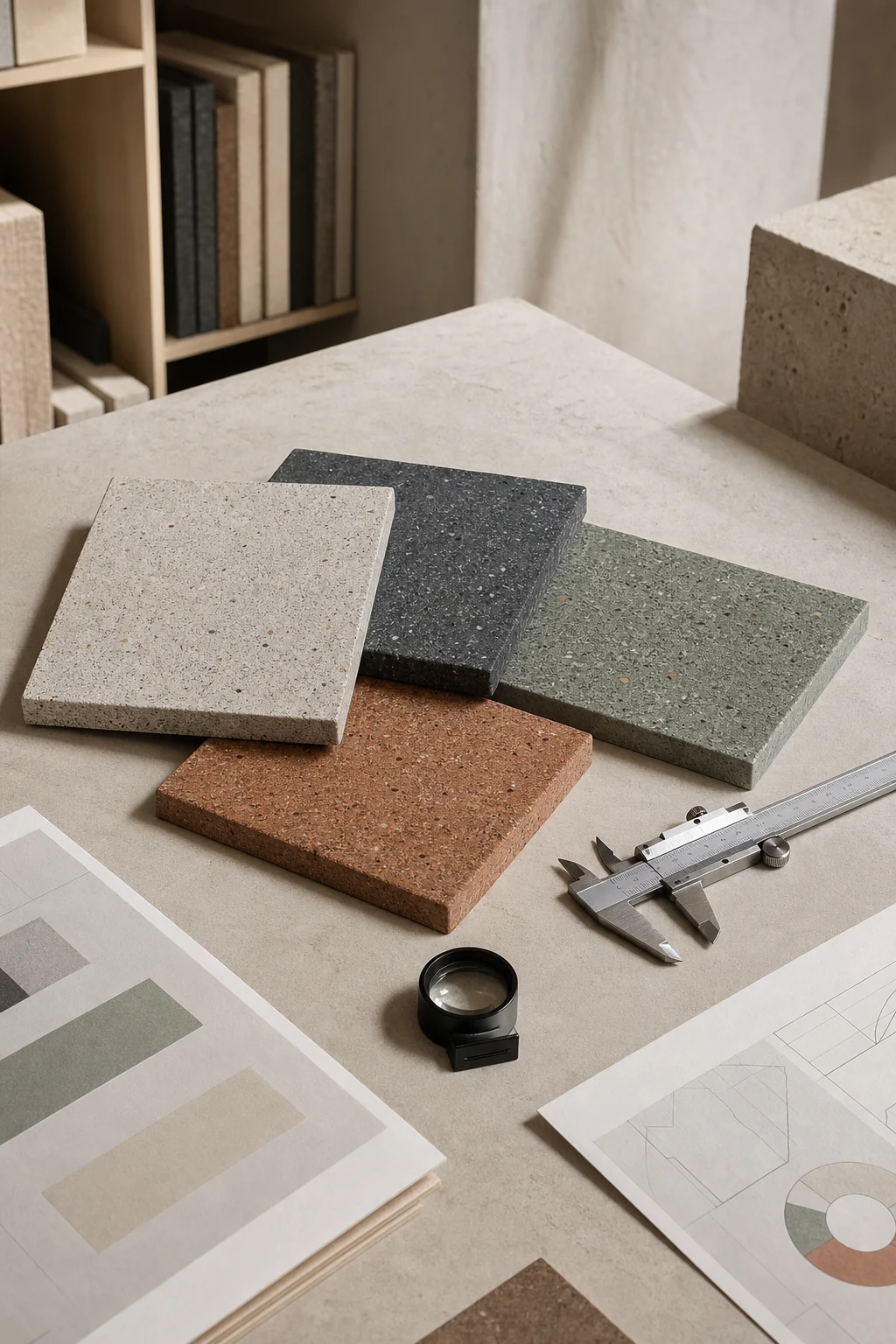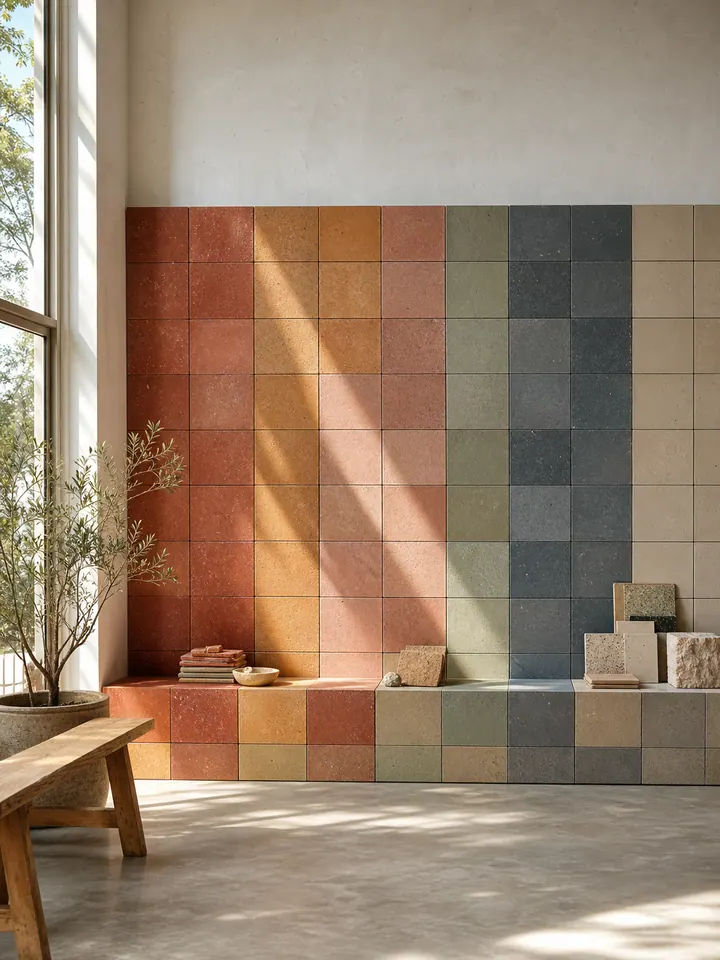
Colour is often the first reason a designer notices a tile, but a mineral surface is never experienced as a digital colour value alone. It is seen across many pieces, under changing light, beside grout and adjacent finishes, and at distances ranging from a few centimetres to the full width of a room.
Recycled mineral tiles can show subtle differences in tone, grain and surface character from piece to piece. This variation is part of the material language, not something that should automatically be designed out. The objective is to understand the expected range, approve it at the right scale and distribute it deliberately across the finished surface.
At the same time, natural variation?should not become a reason to accept anything without review. A successful specification distinguishes intentional material character from damage, contamination, an incorrect finish or a colour range that falls outside the approved sample.
Variation begins with the material itself
CLEM compacted stone surfaces use selected mineral matter, including recovered porphyry, quartz and granite from stone processing. The materials are ground, combined and pressed into new architectural modules. Fine mineral particles and small inclusions remain visible in the finished surface, giving the colour depth that a completely flat printed finish cannot reproduce.
Natural mineral inputs are not visually identical. Pigment, aggregate distribution, pressing, curing and finishing can all influence how a tile reflects light. Even within one colour family, neighbouring pieces may appear slightly warmer, cooler, lighter or deeper.
The current manufacturer guidance describes colour differences as a characteristic of the natural stones used in the compacted material. That statement is important, but the practical design question is still: what degree of variation is expected for this product, colour and finish?
Variation and inconsistency are not the same thing
Considered variation creates movement without making the surface feel uncontrolled. Repeated tiles remain recognisably part of one colour family while their fine mineral grain prevents the installation from becoming visually flat.
An inconsistency is different. Examples that deserve investigation include:
- a piece that sits clearly outside the approved tonal range;
- unexpected staining, surface residue or efflorescence;
- chipped corners, cracks or deformation;
- an incorrect thickness, size, finish or edge treatment;
- contamination introduced during storage, cutting, grouting or cleaning;
- a batch or product code that does not match the approved schedule.
If the difference cannot be explained by the approved material range, set the pieces aside and contact the supplier before installation continues. It is easier to review a concern while the material is loose than after it has been fixed and grouted.
Review a range, not one perfect tile
A single hand sample can confirm the general direction, but it cannot represent a complete floor or wall. Before final approval, view several pieces from the proposed colour, format and finish.
Lay the samples together with realistic joints. Look for the lightest, darkest and most characteristic pieces, then decide whether the group feels balanced at the scale of the proposed application. A reception wall viewed from across a room creates a different impression from a bar front or bathroom surface examined at close range.
For a project using several colours, approve the relationships between them as well as each colour individually. Terracotta and golden ochre may become warmer beside ivory; muted sage may appear greyer next to dusty rose; slate blue can deepen when surrounded by dark grout.
The approval record should include clear photographs, product codes, finish, format, date and the physical samples retained by the project team. The physical material remains the most reliable reference.
Test colour in the project's actual light
Lighting can change the apparent colour more than expected. Cool daylight can clarify blues, greens and fine mineral inclusions. Warm artificial light can intensify ochre and terracotta while reducing the apparent separation between nearby warm tones.
Review samples under the lighting conditions planned for the finished space:
- direct and indirect daylight;
- morning, afternoon and evening conditions where relevant;
- the specified artificial-light colour temperature;
- grazing light on textured or water-washed surfaces;
- reflected colour from timber, paint, metal and upholstery.
Photographs are useful for recording the review, but cameras and screens introduce their own colour interpretation. Do not approve a production colour solely from an image displayed on a phone or monitor.
If the space changes character between day and night, treat both conditions as part of the design. A hospitality surface may need to feel clear and mineral in daylight while becoming warmer and more intimate in evening light.
Grout changes the way variation is perceived
Grout is part of the colour composition. A close tonal match can allow small differences between tiles to merge into a continuous field. A contrasting joint outlines every piece and can make the same degree of variation appear more graphic.
Joint width also matters. A fine grid creates one visual rhythm; a wider joint gives the grout colour greater influence. The selected joint must first meet the product and installation requirements, but its visual effect should be assessed at sample stage rather than left as a site decision.
Build a representative panel with the proposed tile, joint width and grout. If the grout needs to be selected from a coloured range, test more than one option. Wet grout, newly cured grout and fully dried grout may not look identical, so allow the sample to reach its final condition before approval.
Format and finish affect colour depth
The same colour can read differently across formats. A large module presents a broad mineral field, while a mosaic creates a denser pattern of edges and joints. Narrow linear tiles can emphasise directional shade changes, especially under raking light.
Surface finish influences reflection and texture. A straighter, more regular finish can make the module and grid appear precise. A water-washed, tumbled or otherwise articulated finish can emphasise mineral grain, edge character and shadow. Confirm current finish availability for the selected CLEM product rather than assuming every colour is supplied in every finish.
When combining formats, review them together. Even when the colour code is the same, changes in scale, joint density and surface treatment may alter the way the eye reads the material.
Blend boxes before installation
Do not lay one complete box and then move to the next. Current manufacturer instructions recommend mixing pieces from different boxes and pallets during installation. This distributes the expected variation across the tiled field and avoids creating visible blocks that correspond to packaging order.
Before adhesive is applied:
1. Open several boxes from the delivery.
2. Check that product codes, sizes, finishes and quantities match the order.
3. Dry-lay a representative group and compare it with the approved sample range.
4. Identify any pieces that require supplier review.
5. Draw pieces from different boxes as installation progresses.
For complex patterns or several colours, prepare a set-out drawing and maintain the intended colour ratio. 鈥淩andom鈥?placement still benefits from control: avoid accidental clusters, stripes or abrupt tonal zones unless they are part of the design.
Store the material correctly
Material appearance can be affected by site conditions before it is installed. Store compacted stone tiles in a covered, dry location and protect them from contamination, standing water and construction residue. Current installation guidance specifically notes dry covered storage as a way to avoid efflorescence.
Keep labels and packaging information available until the material has been checked. If pallets are separated across the site, maintain a record of which material belongs to each area so that batch review and replacement decisions remain traceable.
Plan for replacement stock
Retained stock is valuable only when it can be identified. Keep an agreed quantity of spare tiles from the supplied material, labelled with the product code, finish, format, project and delivery date.
A future production run may remain within the same colour family while showing a slightly different tonal balance. Spare material from the original project gives the client a better chance of completing a local repair without introducing an avoidable visual change.
Store replacement pieces indoors and protect them from damage and moisture. Record their location in the handover information rather than leaving unlabelled boxes on site.
A colour-variation approval checklist
Before approving or installing recycled mineral tiles, confirm:
- the exact product code, colour, format and finish;
- several physical pieces representing the expected range;
- the relationship between all colours used in the project;
- appearance under the actual daylight and artificial lighting;
- proposed grout colour and joint width;
- a representative dry layout or grouted mock-up;
- the method for mixing boxes and controlling the pattern;
- dry, covered storage before installation;
- the process for isolating unexpected pieces;
- labelled replacement stock for future repairs.
Variation gives a mineral surface life. When it is reviewed, approved and installed deliberately, small shifts in colour and texture create depth rather than disorder. The result feels materially rich while remaining controlled enough for a considered architectural interior.
Explore CLEM colours, formats and finishes, or contact the CLEM Stone Tiles team to request physical samples for a project-specific colour review.
Research notes
Sources & verification
- CLEM product pages, current product data and project-specific sample approvals.
- https://www.clemstonetiles.com/products.html
- https://www.clemstonetiles.com/applications.html
- https://lapietracompattata.it/wp-content/uploads/2026/02/Istruzioni-di-posa-in_PIETRA.pdf
- https://lapietracompattata.it/en/azienda/
Technical suitability and current availability should be confirmed for each project.